Additional Thermodynamic Calculations and Utilities
Thermodynamic property evaluation, using a supported calculation type, involves two aspects. The first aspect is parallelization using our custom utility class. Implementing python’s multiprocessing module requires a sub-wrapper for a single set of thermodynamic system conditions. Thus, a sub-wrapper handles the second aspect, execution of property evaluation. This function is expected to be short, referencing one to three thermodynamic functions. For example, in the solubility_parameter() calculation, the density of the system is computed and then used as an input to compute the Hildebrand solubility parameter. These two thermodynamic functions are found in the calc.py library. This file structure allows the thermodynamics to be compartmentalized in the calc.py module, while data checks, organization, and dispatch are handled by the calculation wrappers that are found and called by the higher level thermo() function.
To add a calculation type that is accessible to the thermo function, a contributor would add a new calculation type and, optionally, functions in the calc.py library. The new calculation type would be accompanied by a sub-wrapper that holds the thermodynamic calculations to allow for parallelization. An underscore should precede the sub-wrapper to signal that the thermo function should ignore it in searching for the proper calculation type. For example:
def solubility_parameter(Eos, **sys_dict):
    ...
    rhol, flagl, delta = MultiprocessingObject.pool_job(
            _solubility_parameter_wrapper, inputs
        )
    ...
    return output_dict

def _solubility_parameter_wrapper(args):
    ...
    rhol, flagl = calc.calc_liquid_density(P, T, xi, Eos, **opts)
    delta = calc.hildebrand_solubility(rhol, xi, T, Eos, **opts)
    ...
    return rhol, flagl, delta
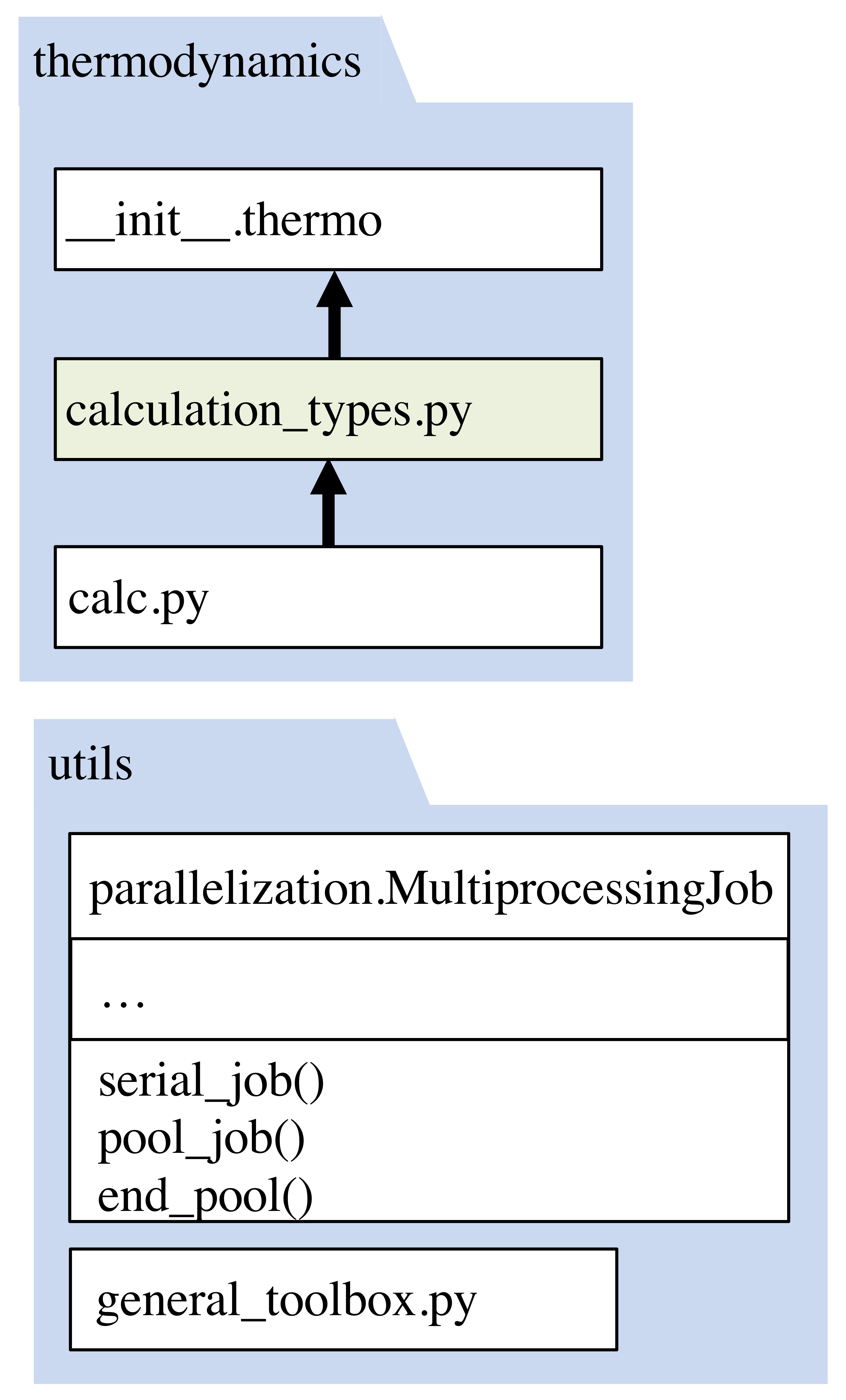
Figure 1: The thermodynamics module employs the thermo() function to handle setting up and dispatching calculations. Any function in the calculation_types module can be discovered through a factory pattern. This module then contains wrappers that assemble supporting thermodynamics calculations from the calc module. A utils directory contains a custom class for parallelization and general functions that are not specific to the syntax and structure of this package.